Boston · Old State House · 42°21′31.57″N, 71°3′28.1″W
History happened here.
The library has left the building.
You are standing on a crime scene. A revolution. A love letter. The city paved over it, but it's not buried. Stand where it happened and read the words that survived. The library is out here.
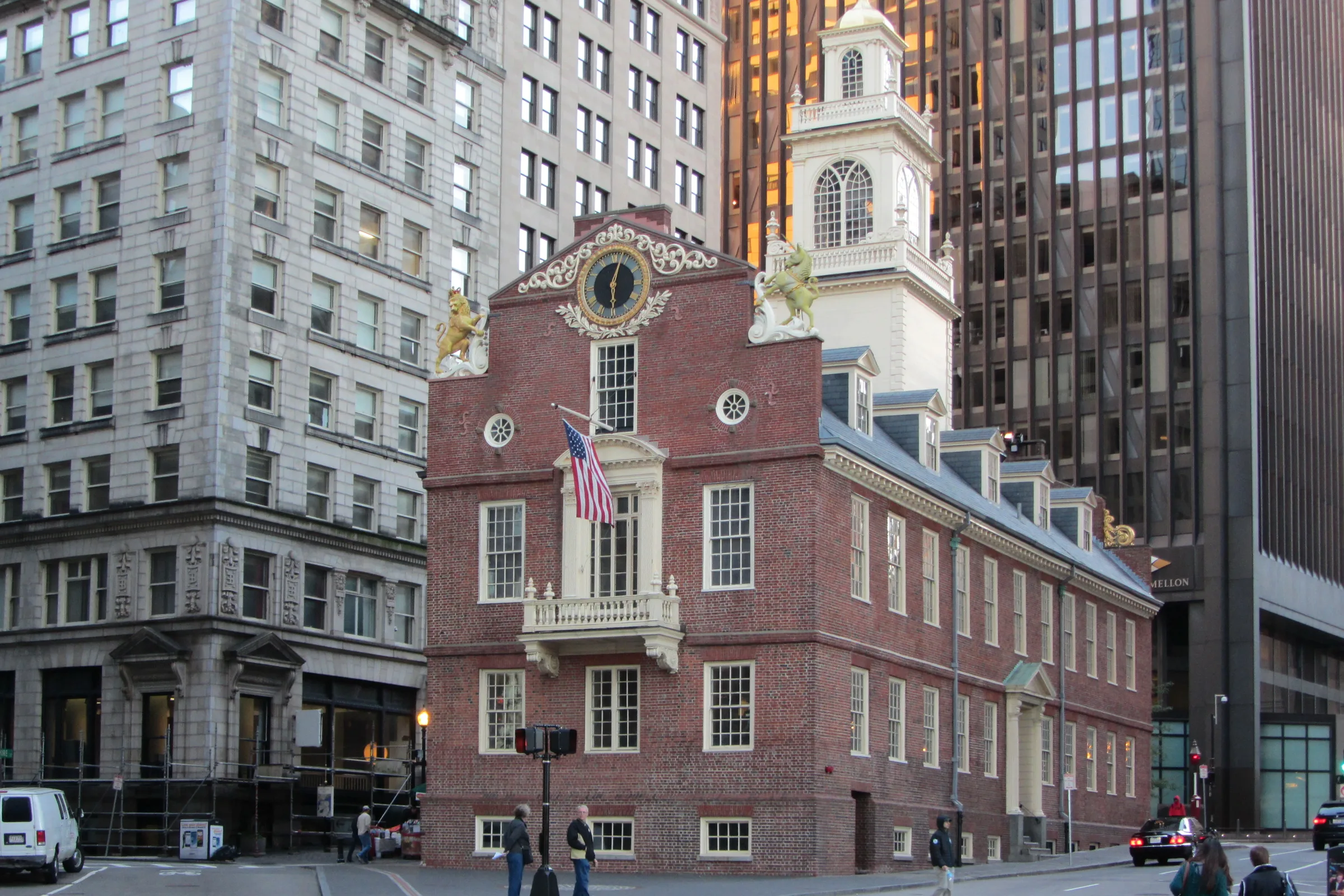
The Old State House, today.
Photo: Robert Linsdell, CC BY 2.0, via Wikimedia Commons. Resized and cropped for display.
The map
Every Edition is drawn in the style of its own time.
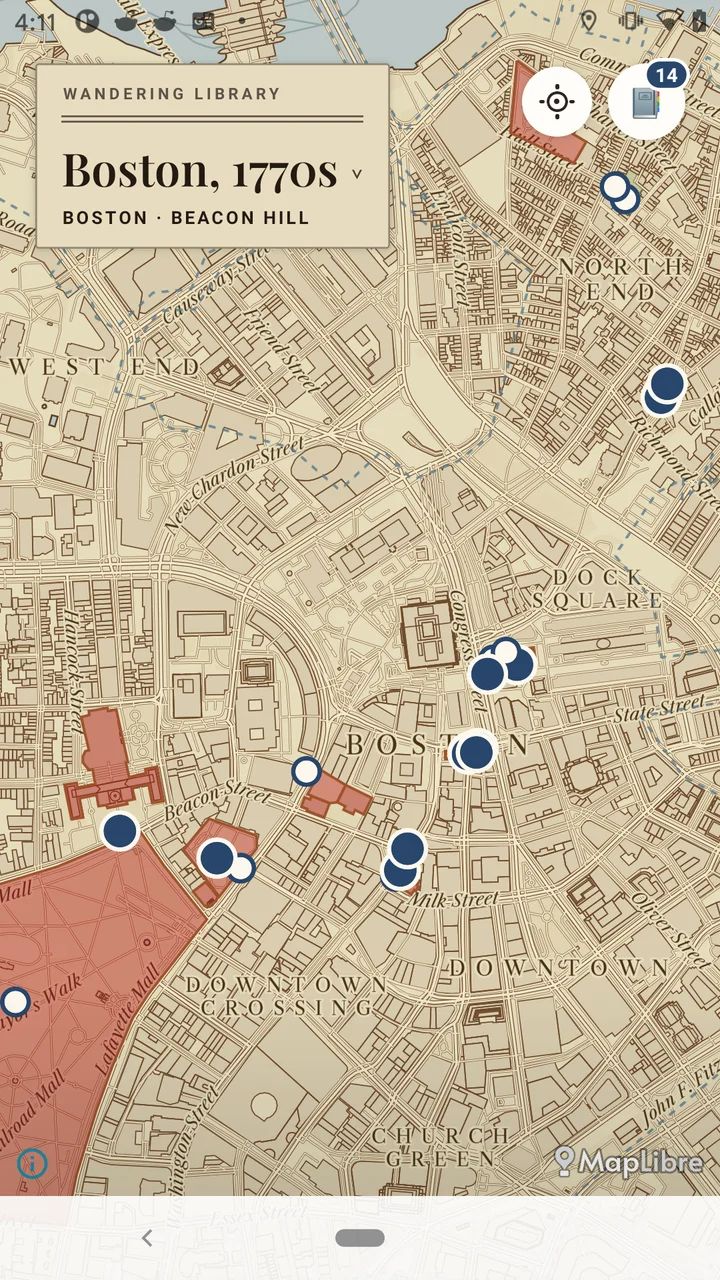
Boston, 1770s — Revolutionary Boston, our first Edition — is set on rag paper in iron-gall brown ink, in the copperplate manner of the engravers who actually mapped this harbor: roman capitals for places, italics for water. It is not a modern map tinted sepia.
That is not a promise for later — it is already true. Old New York draws Gramercy Park in a chromolithograph postcard palette; the WPA City Guide keeps its 1939 federal-writers rule lines; Downtown draws 1970s Union Square in a Swiss-modernist grid. Every Edition gets its own hand, because the map is part of the story. Find your way like they did.
The passages
This ground doesn't belong just to the present.
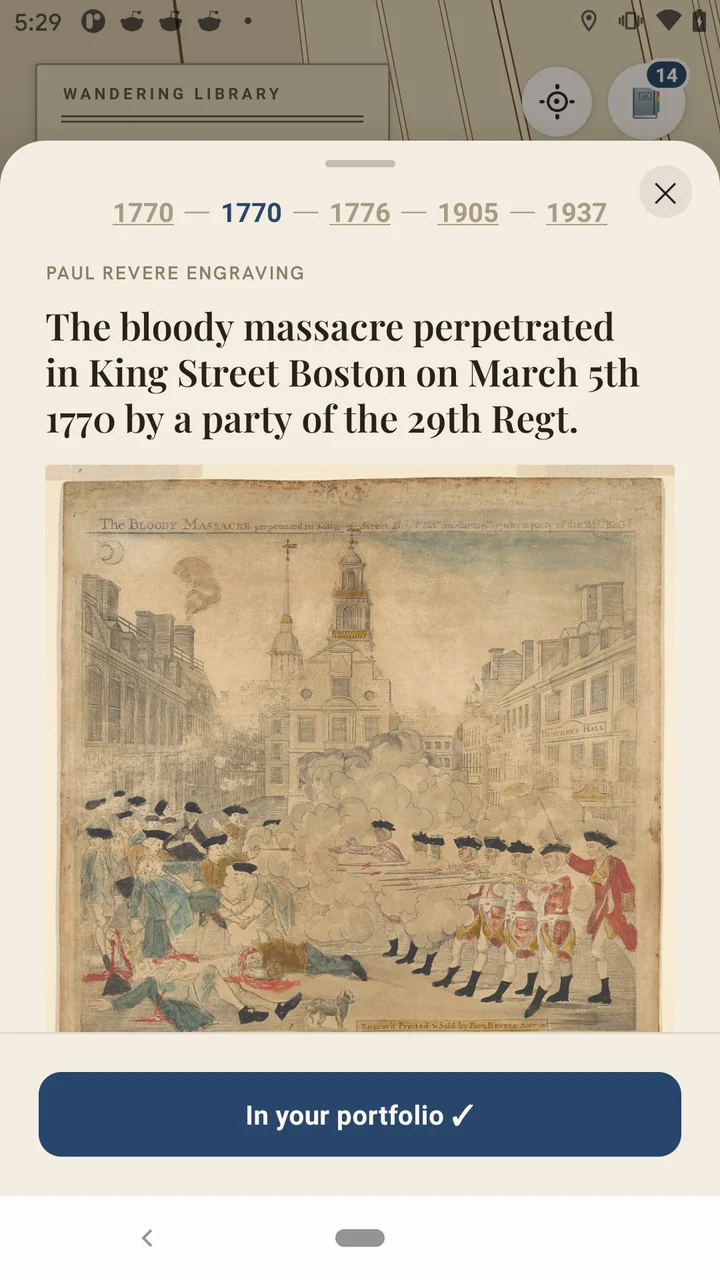
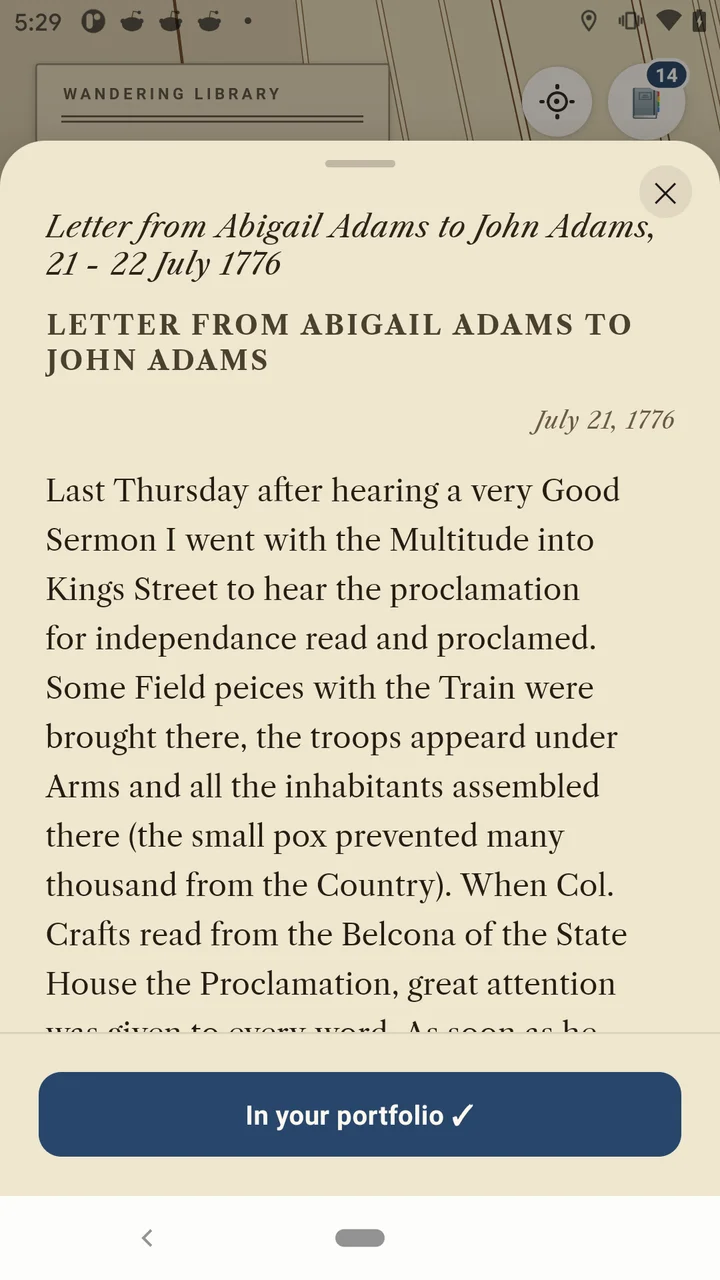
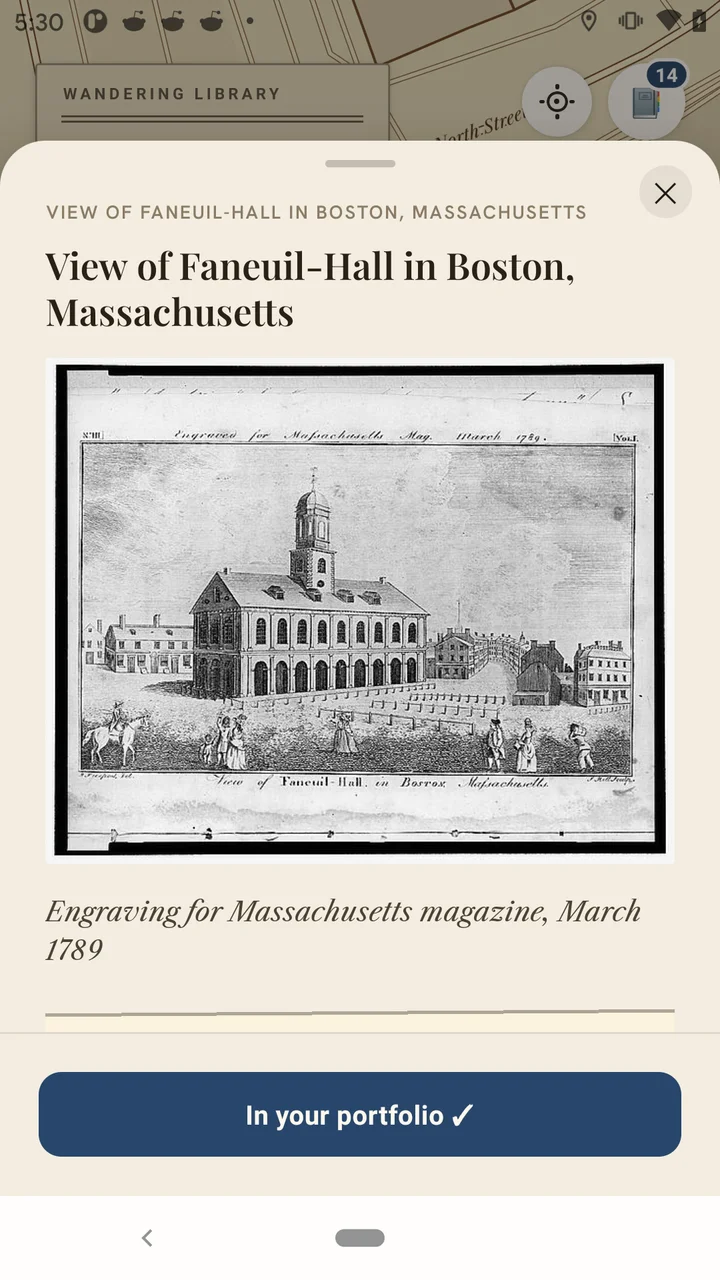
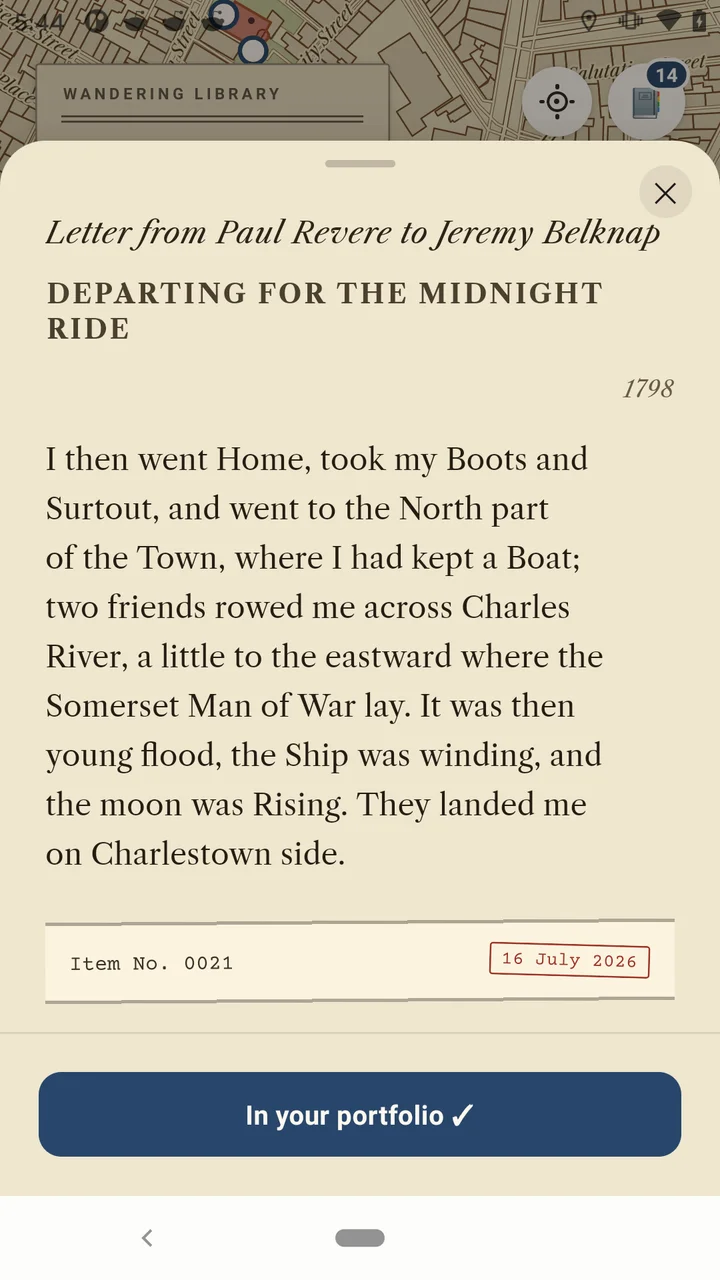
You are standing where someone once stood, looking at something they could not yet know would become history. The library is at the Old State House, where Abigail Adams watched independence proclaimed from its own balcony. At Faneuil Hall it holds up an engraver's view of the market floor from two centuries ago. On Paul Revere's front door is his account of leaving this spot on his famous midnight ride, in his own words. Wandering Library is a way of encountering those traces where they happened. Not behind glass, but under your feet.
The Portfolio
Walk a city, and collect items across the centuries.
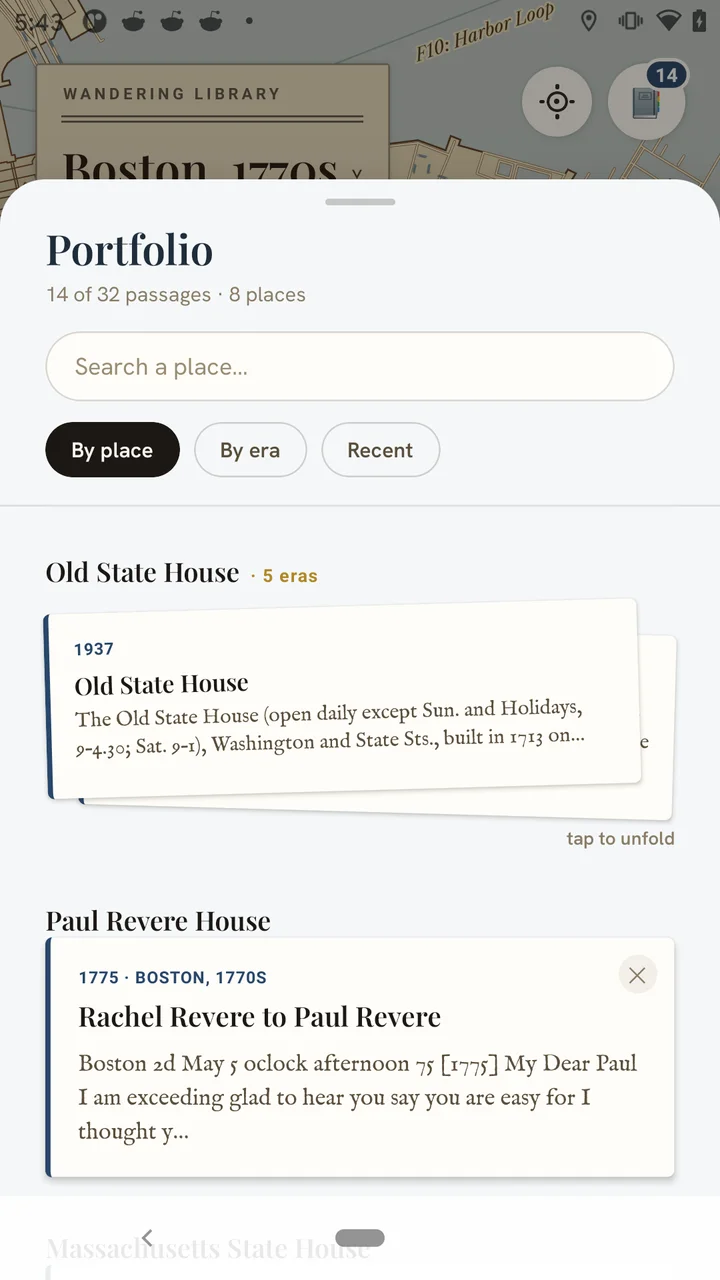
Collected passages are pasted into your Portfolio, dated the day you stood there. The fragment is period, but the note is yours, from your trip.
History lives on the map.
Your trip lives in the Portfolio.
In your Portfolio you can see passages from across time, by place or by era, and it is yours to keep, like a personal travel book already on your shelf as soon as you return home.
Beyond Boston
Boston is the flagship. The format already runs elsewhere.
Revolutionary Boston is where the reading-sheet format runs deepest — every passage checked, every pin still awaiting its walk. The same format already stands up three more eras, in New York, as glimpses of where this goes next. One city was never the plan.
Old New York
1880–1905, Gramercy Park. Drawing rooms and gilded avenues, drawn in a chromolithograph postcard palette.
WPA City Guide
1939, Greenwich Village. The Depression-era federal writers who mapped every block — the app's original edition, in their own hand.
Downtown
1952–1985, Union Square. The few blocks below 14th Street when they were the center of the art world, in a Swiss-modernist grid.
Beat New York — 1955, the Bowery — is arriving this fall. And a second Boston Edition, Abolitionist Boston, is already being sourced and mapped.
For institutions
Curiosity is the product. The wanderers are not.
You have the artifacts. The city has the coordinates. Wandering Library gives your institution the engine to put your archives back out into the world, exactly where they were born.
Wandering Library is built and designed to honor the trust we have in libraries. User data is given the highest privacy — not collecting it by default. And for the historical passages on the map, Partner institutions can correct them, overrule them, or walk away from them without leaving a mark on their building.
Location data is private
Geofences are evaluated entirely on the device. Timestamps are rounded to the hour. No third party analytics.
This is a statement about capability, not just policy. Wherever possible, the app will not collect data by default. No third party data sales, not even analytics.
Curatorial veto
Partner institutions can review every passage. Those sited at a Partner’s property are subject to that institution’s veto.
Editions are versioned data sets delivered straight to the app. A correction does not wait on an app-store update.
Nothing permanent asked
No plaques. No markers. No hardware. Nothing affixed to a facade, which means no permitting and no precedent.
Sources
Provenance first. Every passage carries its citation into the book.
The source appendix is not written after the fact — it is part of the data model from the start. Every quotation is checked against a digitized copy of the cited edition before it goes on the map: when a half-remembered phrase turns out not to be in the book, the passage follows the document, not the memory. A sample of the Boston passages and their sources:
Sources are chosen so that history is not narrated only by the people already on the plaques. A few passages we went looking for — a Loyalist's telling of Sam Adams, a minister's letter on the siege — couldn't be verified against a public-domain edition, so they aren't here yet. We'd rather leave a gap than guess.